Blog ·
When a song uses more than one language: keep meaning in the picture

Many songs move between languages: a chorus in one, verses in another, a phrase from a grandparent's language in the bridge. Those switches usually carry meaning. When a cover is built from a literal translation, it often loses exactly the part that mattered, or worse, fills the gap with clichés about a place or culture. The fix is a short meaning note for the lines that matter, and a fluent person to check it.
Original, literal, intended
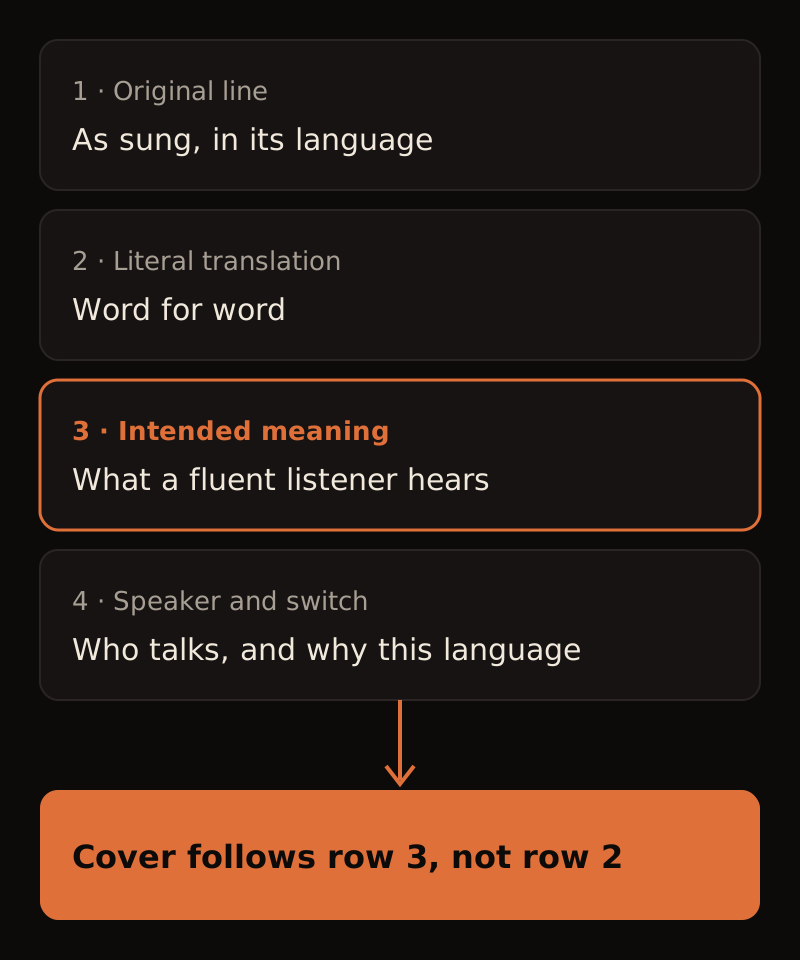
For each line that will shape the cover, write three versions:
- Original: the line as sung, in its language.
- Literal: a word-for-word translation.
- Intended: what a fluent listener actually hears, including tone.
The cover should follow the intended meaning. Literal translations of idioms produce strange images: a phrase that literally mentions an animal or a body part may simply mean "I'm exhausted" or "don't worry about it". Picture the animal and you have illustrated a word, not the song.
Who speaks, and why they switch
Code-switching is rarely random. A singer might use one language for public feelings and another for private ones, quote a parent in their language, or switch to land a joke. Add a fourth line to the note:
- Speaker and switch: who is speaking in this line, to whom, and what changes when the language changes.
That line often gives you the cover. If the song is in one language until a single line spoken to a mother in another, the cover may be about that private moment rather than about either language.
Avoid the shortcut to stereotypes
When the meaning is unclear, images tend to fall back on surface markers of a place: flags, landmarks, costume, a generic "cultural" pattern. These rarely reflect the song, and they can flatten a personal story into a postcard. A good test: would this image fit any song from this region? If yes, it is not about your song. Go back to the meaning note and look for the specific situation instead.
Cultural detail is welcome when it comes from the song or from the artist's own life: the actual street, the dish in the second verse, the fabric of a relative's coat. Specific is respectful; generic is not.
Get a fluent collaborator
If you are not fluent in every language in the song, ask someone who is to read your meaning note. Ask them three questions: is the intended meaning right, is there a double meaning I missed, and does anything in my cover direction feel wrong to you? Machine translation can help you draft the literal line; it is not a reliable judge of idiom, tone or slang. Treat any automated reading, including the one in any cover tool, as a first draft to be checked.
A worked example (illustrative)
This example is invented and deliberately language-neutral. A song is mostly in Language A. In the last chorus, the singer switches to Language B for one line. Literally the line says "the kettle is still warm". The artist's fluent co-writer explains that, in her family, it is what you say to someone coming home late: you were expected, you are welcome.
The literal reading would put a kettle on the cover. The intended meaning suggests something else: a doorway left open, a second cup set out, a light in one window. The co-writer prefers the second cup, because it is something her family actually does. That is the cover.
Copy this meaning note
Line (original):          ______________________
Literal:                  ______________________
Intended (fluent check):  ______________________
Speaker → listener:       ______ → ______
Why the switch:           ______________________
Checked by:               ______ on ______
Cover follows:            the intended meaning, specifically ____
Avoid:                    ____ (literal image / generic place marker)
For a song where the sound and the words pull apart, our guide to emotional contrast uses a similar note. For choosing one subject, see what cover art should show.
Bring the note with you
Soundae reads lyrics and listens to the song. If a line in another language matters, you can describe its intended meaning in your own words when you refine a direction, and you should still check the result with someone fluent. Start with your song.