Blog ·
When the beat feels dark but the words offer comfort

Some songs sound heavy and say something gentle. A slow, minor-key beat under a lyric that tells someone they are safe. A distorted bass line carrying a love song. If you design from the sound alone, you get a cover about dread; if you design from the words alone, you get a cover that looks nothing like the record. The strongest covers for these songs usually keep both, but give one of them the lead.
Separate the production from what the words mean
Start by writing two short descriptions, and keep them apart.
The production: tempo, weight, space, texture. "Slow, low, lots of reverb, a cold synth pad, the kick sits far back." These are facts about the sound. They suggest light, colour, density and how much empty space the picture needs.
The lyric meaning: what the words actually say, in plain language. Not what the mood of the beat suggests they mean. "Someone is telling a friend who cannot sleep that she can stay as long as she needs." If the words say comfort, the song is about comfort, even when the sound is dark. A heavy beat changes how comfort feels (tired, late, hard-won), not whether it is there.
Only conclude that the comfort is false or ironic if something in the song supports it: a line that undercuts it, a turn in the last verse, or the artist telling you that is the point.
Who is speaking, and to whom
The same words change depending on the speaker. "You can stay" from a parent, a lover, an old friend or the singer to herself are four different covers. Write one line:
- Speaker: who is talking.
- Listener: who they are talking to.
- Situation: where and when, if the song tells you.
This is often the detail that makes a cover specific. A doorway is generic; a doorway opened by someone who has been waiting up is a story.
Leading feeling and secondary feeling
Name one leading feeling and one secondary one. In our example, comfort leads, and the late-night tiredness of the production is secondary. The lead decides the subject and the brightest thing in the frame. The secondary feeling goes into the atmosphere: the colour of the surroundings, the time of day, the amount of shadow.
Reversing them is a choice, not a mistake, but make it on purpose. A song that is mostly about fear, with one comforting line, may want tension in the lead.
Three ways to read the same song (illustrative)
Here is an invented song to test against. The lyric is about letting a friend in at three in the morning: "Leave your coat on the chair, I'll put the kettle on." The production is dark, slow and cold.
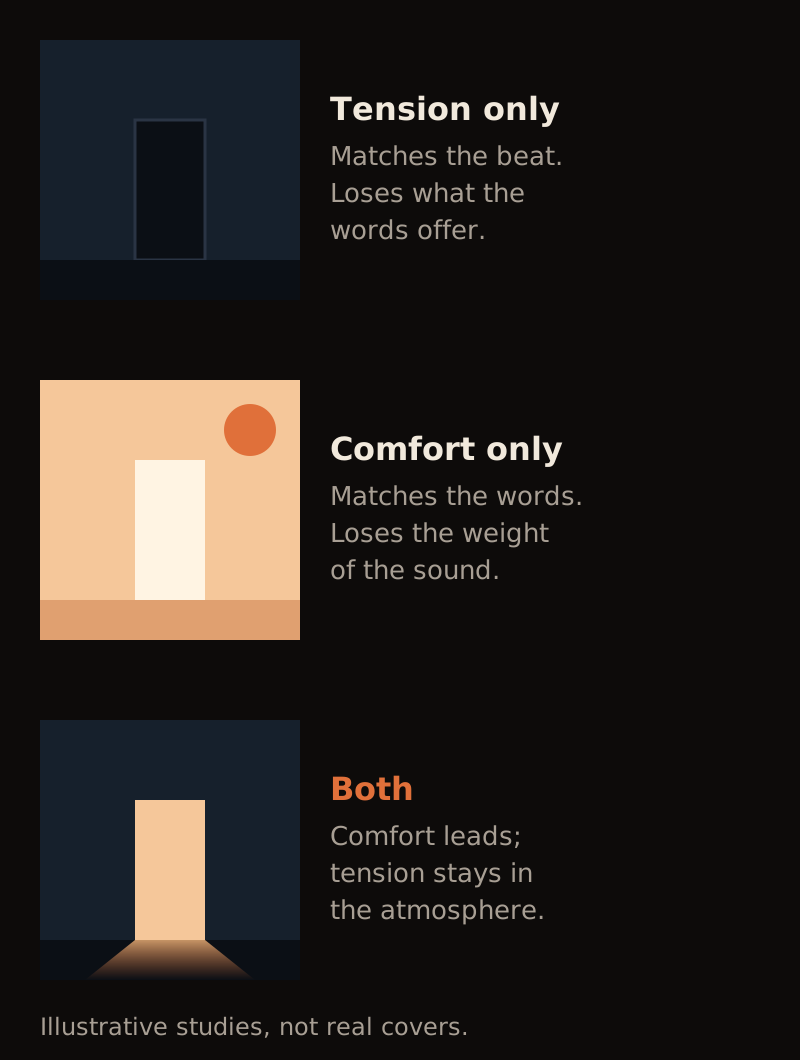
- Tension only. A shut door on a cold blue street. It matches the beat and ignores the invitation. Listeners who know the words will feel the cover is about a different song.
- Comfort only. A bright, warm kitchen. It matches the words, but the record sounds nothing like this. The cover promises a different listening experience.
- Both. The cold street stays, and one open door spills warm light across it. Comfort is the subject; the dark sound is the world around it.
None of these is objectively right. The third is usually the most honest to both halves of the song, and it tends to read clearly at small sizes because there is one bright focal point. Our guide to what cover art should show goes further into choosing a single subject.
Copy this exercise
Fill in the blanks before you brief anyone, including yourself:
This song is about ______________________ (what the words say, plainly).
Speaker → listener: ______ → ______
Keep ______________________ in the atmosphere (what the sound adds).
But don't make it ______________________ (the reading the beat suggests
and the words don't support).
For our example: "This song is about letting a friend in when she can't sleep. Speaker → listener: the singer → an old friend. Keep the cold, late-night stillness in the atmosphere. But don't make it a cover about loneliness or threat."
That last line does most of the work. It stops the production from quietly rewriting the song.
Check it small
Contrast covers often depend on one small warm area inside a lot of darkness. On a phone, that area can shrink to a few pixels. Put the cover in a grid on your phone and make sure the warm part is still visible; our phone check explains how.
Try it with your own song
Soundae listens to the song and reads the lyrics, and proposes directions you can keep, pass on or refine in your own words, including a note like the one above. Results vary from song to song; you stay the judge. Start with your song.