Blog ·
Stop illustrating every lyric: three ways to use a metaphor
Songs are full of images: lights, roads, rain, hearts, mirrors. It is tempting to put several of them on the cover so it feels "about the song". Usually the opposite happens. A cover that illustrates five lyrics says nothing in particular, and at thumbnail size it is a jumble. A stronger cover picks one metaphor and decides how to show it.
Here are three ways to do that, using one original line written for this article:
I left the light on for a version of us.
Way one: the literal object
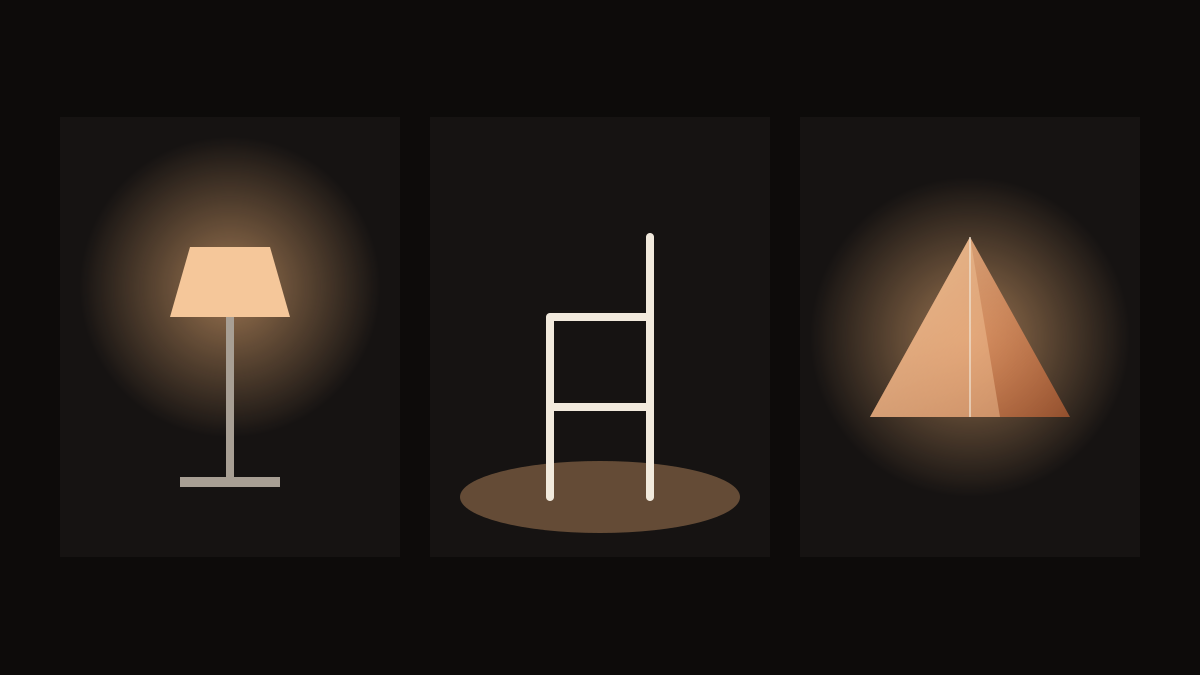
Show the thing the line names, but give it a particular situation. Not "a light", but one lamp, still on, in a room where everyone has gone to bed. The object is plain; the situation carries the meaning.
When it works: when the object is unusual, or the moment around it is specific. A lamp alone is common; a lamp left on at the end of a hallway, door half open, is a scene.
Risk: objects can be read as decoration rather than meaning. Give the object a reason to be there.
Way two: the aftermath
Show what the metaphor leaves behind instead of the metaphor itself. "A version of us" is someone who is not there. So show where they would be: an empty chair turned toward the door, in the pool of light from the lamp you do not see.
When it works: for songs about absence, memory, waiting. The viewer fills in the missing person, which makes the cover personal.
Risk: empty rooms are common. Make the aftermath precise: one chair, turned a particular way, is better than a whole empty house.
Way three: physical abstraction
Turn the feeling into a material behaving in a particular way. A sheet of translucent amber paper, folded once, lit from inside, so the fold makes one half brighter than the other. No lamp, no chair. The paper does what the line does: holds warmth for something that has two sides.
When it works: for songs whose sound is more textural than narrative, or when literal objects feel heavy-handed. Abstraction is not vaguer; it needs a very specific material and behaviour to land.
Risk: "abstract" can slide into generic swirls and smoke. If you cannot name the material and what it is doing, it is not yet a direction.
Options, not right answers
None of the three is the correct one. The literal lamp suits a quiet acoustic recording; the empty chair suits a song that tells a story; the folded paper suits a slow, atmospheric production. Try all three in a sentence each before choosing, and choose the one that matches how the song sounds as well as what it says. Our guide to what cover art should show has more on choosing one subject.
Remove redundant symbols
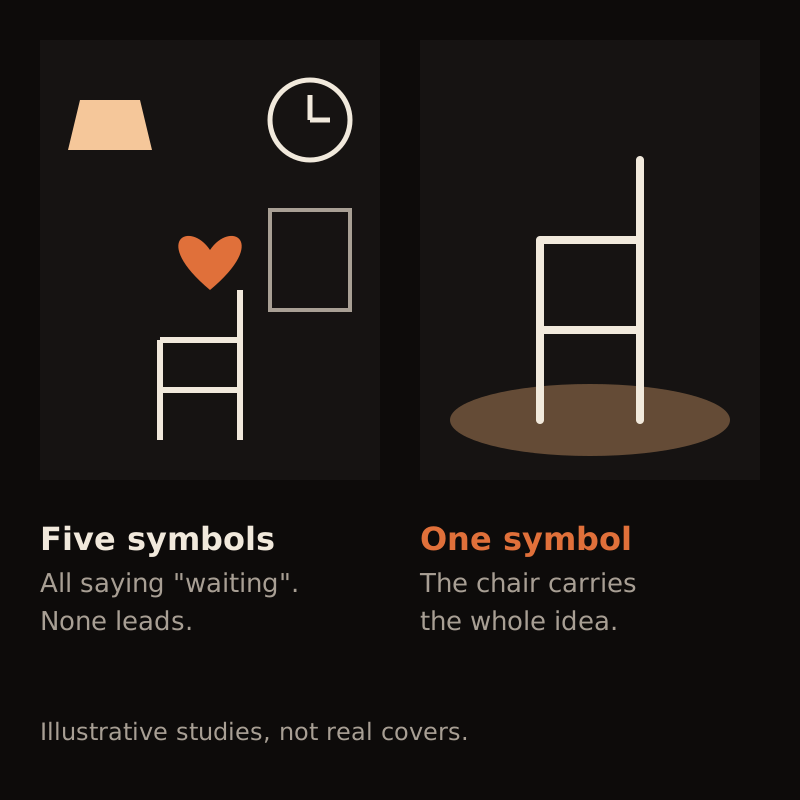
Once you have a direction, look for anything else in the picture that says the same thing. A lamp, a clock, a heart, a window and an empty chair all say "waiting". Together they compete, and the cover says "waiting" five times quietly instead of once clearly. Keep the strongest; remove the rest. If you need more, add something that says something different: the time of year, the weather, one detail of the room.
A worked example (illustrative)
An invented songwriter has a song with a lamp, a train, a coat, rain and a phone in its lyrics. She lists them, notes that the chorus keeps returning to the lamp, and writes three directions: the lamp left on at the end of a hallway; a coat still on its hook beside an empty chair; amber paper folded around a light. She chooses the coat and chair, because the song is about someone who has not come back, and drops the train, rain and phone from the picture entirely.
Copy this exercise
The line: ______________________
Literal object:   one ____ in this situation: ____
Aftermath:        what is left behind: ____
Physical abstraction: material ____ doing ____
Chosen: ____ because the song sounds ____
Remove: anything else that also says ____
Then check it small with our phone check: one symbol should still read at thumbnail size.
Try it with your song
Soundae reads your lyrics and listens to the song, and proposes directions you can keep, pass on or refine. You can describe what to change in your own words. Start with your song.